
September, 2022
Like I’ve said before, your body will talk to you a lot when you meditate. My body talks a lot louder than my thoughts, and even though I know it is a good idea to be “in touch” with you body, sometimes I miss the times when I had no awareness of it at all. Then again, maybe some of that is just that it gets louder as you get older, whether you meditate or not. I usually position my hands either upright on my thighs, or palms down on my thighs, or sometimes with my hands cupped in front of me. More than once, I’ve suddenly noticed that my hands have clenched into fists, the exact opposite of the relaxed, intentional posture you’re looking for. I don’t have any particular wisdom to share about how to prevent it, just notice and relax. What I can tell you thought, is that the more often I catch it in meditation, the more often I catch it during the rest of my day – finding some part of me that is clenched tight for no apparent reason. I take it (in a purely non-scientific way) as an indication that my fight or flight response has been triggered, or in my case, spends most of its time triggered, and that’s just not sustainable, at least not without consequences.

August, 2022
It seems like for most of my life I went about my business and my body did most of what I wanted it to without bothering me too much. It’s possible that what I experience when I’m meditating has nothing to do with meditation and everything to do with just getting older.
Here’s what I’m talking about. Almost without fail, my body talks to me as I’m sitting there. I’m not just talking about a foot that falls asleep because my legs have been crossed too long. I’m talking about aches that show up that I didn’t even know were there. I’m talking about feeling like when I take in one of those deep breaths, it goes in deeper on one side of my body than another. I mean noticing that there are places tensed that don’t at all need to be tensed.
Truth is, this is one of the things that carries over into everyday life in a way that can be very good and can be very obsessive. The good part is it gives me important information sometimes – lets me know that I’m putting myself under stress for no good reason. The bad news is, it is impossible to know exactly what is normal. I don’t know what you might find, but for me I’m constantly getting evidence that the left side of my body and the right side are not the same – they don’t inhale the same, they don’t exhale the same, they don’t have the same range of motion. Apparently that violates some expectation I have that even is better – another challenge in my quest for non-judgement and releasing expectations.

July, 2022
It is inevitable that you’ll get interrupted, so then what do you do? Maybe the interruption is self-inflicted, a phone call you just can’t ignore, or maybe it is someone walking in the room. Do I give up for the day, or start from where I am, or start over at the beginning, whatever I consider the beginning to be? I usually decide based on how far along in my sit. If I’m sitting for 25 minutes, and something happens around minute 18, I usually just call it done. On the other hand, if I’m only five minutes in, I’ll try pretty hard to just restart. I don’t have any magic formula to keep people from interrupting you – you can negotiate with the adults you live with and hope they understand, but if you’re trying to do it with kids in the house, no guarantees. The good news is that one of the attitudes you try to cultivate with meditation will help you here – when the inevitable inevitably happens, you don’t have to react to it, you can just say “of course” and get back to business as soon as you can.
June, 2022
Two of the most common questions I hear, or hurdles people seem to anticipate, center around time.
The first challenge is finding the time. There is no question about it, I’m fortunate in the sense that I have space and I have opportunities for privacy. That takes away for me a lot of obstacles that many other people face.
I first wrote this piece in 2020, so the challenges that people had at the time with sharing space exploded, trying to accommodate work at home and school. Maybe, though, it has also led to more explicit negotiation around time and space for a little privacy if you live with other people. In a perfect world, it’s nice to pick the same time every day, and the same place is nice too, but if that’s not possible, there are a lot of people that jump in the car, drive to the edge of a parking lot somewhere, and just sit there. Or walk outside and sit under a tree. Or literally disappear inside a closet.
The real issue is setting aside the time, giving it a priority. It isn’t really that different from finding time to work out, and for some it is just as painful, but like any other habit, if you can just stay with it for about 30 days, you will probably get a pretty good imprint. You can find the time for at least five minutes, you know you can, just decide.
That leads to the next issue, how much time? I started at 15 minutes, I think, then moved to 20, and a couple of years ago to 25 minutes a day. There are a couple of other things that are part of my personal ritual that make it about 30 minutes start to finish. But there is nothing magic about that, no specific time that makes it successful or not. You can start with one breath, then three breaths, then five minutes. There is an Arthur Ashe quote that comes to mind: “Start where you are, use what you have, do what you can”.
March, 2022
I’ve meditated in lots of different places – more hotel rooms than I can count – but my favorite nest ever is the place where I sit most days at home in Chicago.
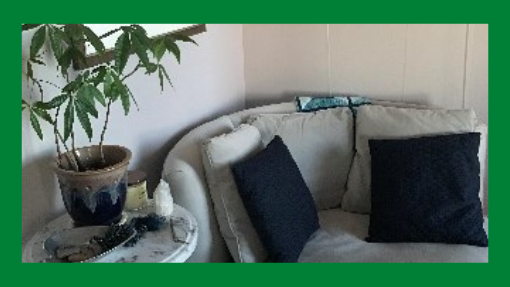
My husband and I have kind of an unusual living situation – we have two condos in the same building downtown right at the lakefront. In one, we sleep and entertain and spend Sunday mornings reading the paper and he spends his days in his office. The other is my daytime domain – my office, my art studio, my main prep kitchen, and my meditation corner. That’s it in the picture you see. I don’t even know what you call this chair – it spins, it’s nice and deep, and it’s got a bunch of pillows to tuck in here and there. I keep a few things on the table next to me, not al altar exactly, just little symbols that mean something to me. There’s a candle – I don’t light it, but I can smell it and something about that smell sets the mood for me.
There are several malas, prayer beads or necklaces depending on your point of view. You’ve seen them before, they are kind of boho-fashion, but they also have a long history, with meaning to the number of beads and the way they are sectioned off. I guess you could say that they are the Eastern religion corollary to rosary beads for Catholics. Anyway, for me they don’t have any specific religious meaning, they are something nice to hold on to – bringing in that sense of touch. I’ll tell you another thing, one of my personal themes is the idea of uniting left brain and right brain, art and commerce, intellect and intuition, so looping that string of beads around both hands, uniting them, has personal symbolism for me.
And yes, there are crystals – selenite, a gift from a friend, and a few others I’ve been gifted along the way. I’m not an expert in crystals, and I don’t spend much time thinking about whether or not they have attributes or powers. I do know that the selenite is said to clear negative energy, and the idea of something from the earth supports the idea of being grounded, and both of those concepts appeal to me.
So, all together, these symbols may not make magic themselves but they lend meaning and are helpful reminders of what I want for myself.
